Olongapo
I’ve mentioned Olongapo many times throughout this journey, but I’ve never really stopped to explain it — not the place itself, and not what it has meant to me over the years. I’ve referenced it in passing, hinted at memories, brushed against the edges of what it once was in my life. But I’ve never taken the time to sit with it, to look at it closely, or to acknowledge how deeply it shaped me.
Maybe that’s because Olongapo has always lived in two versions in my mind: the one I knew in my young adulthood, and the one I returned to fifty years later.
The Olongapo I carried with me all these years was a place of rhythm and familiarity, a place where the streets made sense and the days felt open. The Olongapo we visited on this trip was louder, busier, more crowded, and in many ways unrecognizable. Yet beneath the noise, I could still feel the faint outline of the city I once knew — like a memory pressed under tracing paper.
This chapter isn’t about nostalgia. It’s about acknowledgment — of time, of distance, of growth, and of the quiet ways a place can stay with you even when it no longer looks the same.
The Emotional Contrast Between Past and Present
When I was young, my mom’s restaurant sat in front of a living aquarium — a natural reef alive with bright corals and fish in every color. I can still picture it clearly: the water so clear you could see the movement beneath the surface, the flashes of blue and yellow, the way the sunlight hit the corals just right.
Now that entire area is covered in volcanic ash — the long‑lasting imprint of Mount Pinatubo’s eruption — a landscape nothing like the one I grew up with.
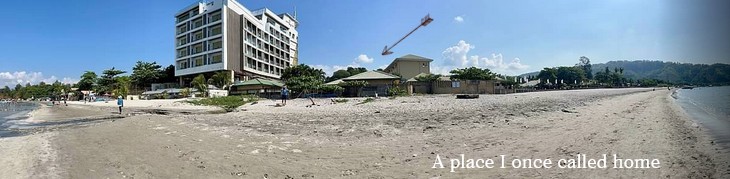
At night, I used to look up and see stars — a sky so open and dark that the constellations felt close enough to touch. Now, instead of stars, the skyline is filled with hotels, neon lights, and loud music spilling into the night. The quiet darkness I once knew has been replaced by a brightness that never seems to turn off.
I remember fishermen pulling in their nets when they spotted a school of fish, their silhouettes moving in rhythm with the tide. That scene was part of the heartbeat of the place. Today, the shoreline is filled with jet skis cutting across the water, the sound of engines replacing the soft pull of nets and the quiet conversations of men who knew the sea.
I wouldn’t say it’s bad — it’s simply different. But it isn’t the Olongapo I carry in my memory
Standing Between Then and Now
I wasn’t trying to step back into the past. I was learning how to stand in the present, even when it didn’t match my memories. Seeing Olongapo as it is now made the old version harder to protect, and the sadness of that hit me harder than I expected — the kind of ache that comes when you finally recognize what’s been lost.
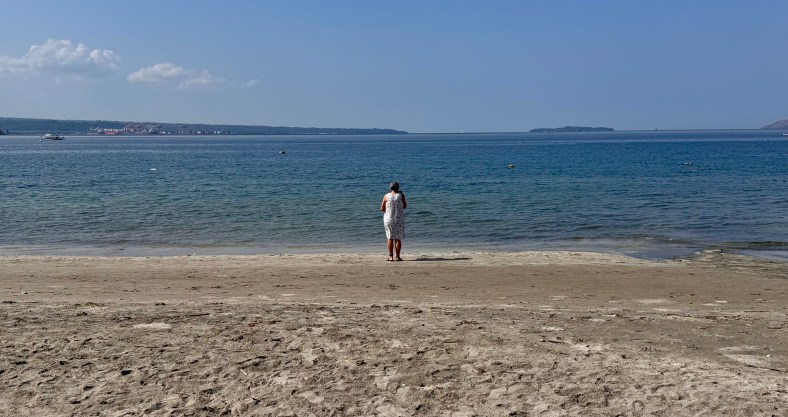
I stood on the edge of the now‑sandy beach, looking out toward Grande Island — the one view that hasn’t changed — and in that moment I understood something important: the Olongapo I loved still exists, just not in the physical world. It lives in memory, in the girl I was, in the moments that shaped me. And even through the ache, I felt a quiet kind of belonging, different than before, yet still real.
Our Turn to Say Goodbye
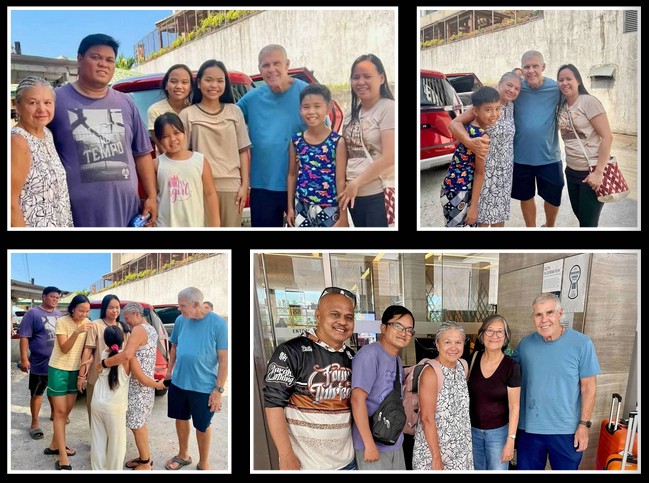
And then it was our turn to go to the airport — our turn to say goodbye. We hugged our wonderful family and friends, thanking each of them for the time, the generosity, and the warmth they shared so freely. It was a farewell filled with gratitude, the kind that lingers long after the moment has passed.